More
Information
Why Talking Isn’t Enough
Talking can be powerful – but it’s not always enough. That’s because trauma, emotional memory, and core patterns are often stored in parts of the brain that don’t use language. Talk therapy mainly engages the left hemisphere and neocortex – the thinking, verbal parts of the brain. However, emotional healing also requires access to deeper systems: the right hemisphere, the limbic system, the nervous system and the brainstem, where unprocessed experiences, implicit memory, and nervous system responses are held.
That’s why I integrate approaches that engage the whole brain and body, not just the thinking mind. These methods are gentle, effective ways to reach and release what talking alone can’t touch.
Getting to Know All Parts of You: Internal Family Systems (IFS)
Internal Family Systems helps us make sense of the different “parts” within us; those inner voices or patterns that sometimes feel at odds. You might have a part that wants to move forward, and another that feels stuck or scared. Rather than trying to silence or fix these parts, IFS invites us to understand them. Each part has a reason for being there, often rooted in protection or past experience. When we get curious with compassion, these parts soften, and we can reconnect with our core self – calm, clear, and capable of leading from within.
What is Internal Family Systems therapy?
https://www.verywellmind.com/what-is-ifs-therapy-internal-family-systems-therapy-5195336
When Words Aren’t Enough: Sand Tray Therapy
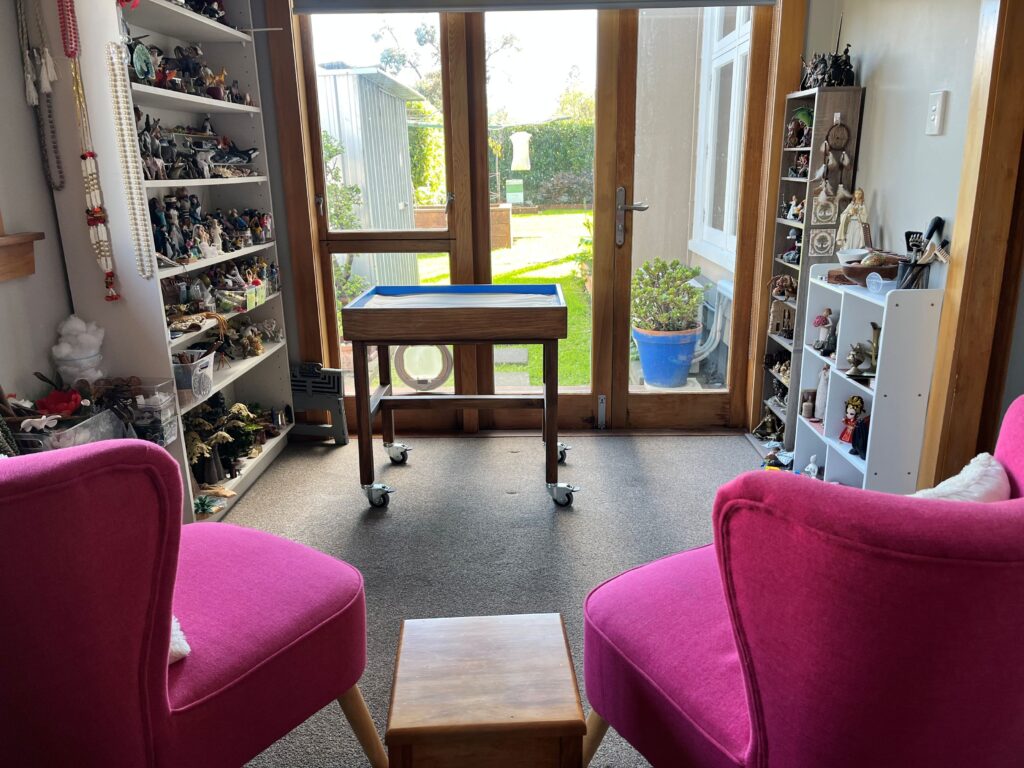
Sand tray therapy is a creative and powerful way to explore thoughts, feelings, and experiences that can be hard to express in words. Using a tray of sand and a collection of miniature figures, you or your child can create scenes that reflect your inner world, consciously or unconsciously. These scenes often reveal what’s beneath the surface, helping us see patterns, express emotion, or process pain in a safe and contained way.
For children, the tray becomes a natural space for storytelling, play, and emotional expression. For adults, it often helps bypass the thinking mind and access symbolic, deeper layers of the psyche, especially when talking feels overwhelming, stuck, or limited.
Sand tray therapy engages and connects both the right and left hemispheres of the brain, allowing for emotional integration and insight through images, sensations, and meanings, not just logic. Whether you’re navigating grief, trauma, identity shifts, or simply trying to make sense of a situation, the sand offers a gentle and surprisingly revealing path forward.
What is Sand Tray therapy?
https://www.verywellmind.com/what-is-sand-tray-therapy-4589493
Brainspotting: Unlocking Your Brain’s Natural Healing
Brainspotting is a powerful tool for accessing and releasing trauma and emotional pain stored deep in the brain and body. It works by identifying specific eye positions that correspond to unprocessed material, often beyond conscious awareness. By simply noticing where the eyes naturally focus during distress or emotion, we can access the brain’s innate ability to process and heal. Unlike traditional talk therapy, this approach bypasses the thinking brain and goes straight to the implicit memory source, which we often can’t remember. This allows for deep shifts without reliving or retelling painful stories.
What is Brainspotting?
https://www.verywellmind.com/brainspotting-therapy-definition-techniques-and-efficacy-5213947
Somatic Work: Discovering What Your Body Already Knows
Our bodies carry the imprint of our experiences, especially when those experiences were too much, too fast, or too soon. Somatic work helps us tune into the nervous system’s subtle signals: tension, numbness, gut feelings, racing hearts. These are not “just symptoms,” they’re messages. Instead of talking about stress or trauma, we learn to feel and respond to what the body is telling us. Through gentle awareness and regulation, this work helps release survival responses (such as fight, flight, or freeze) and create greater safety, calm, and presence in the body.
What is somatic experiencing?
https://www.verywellmind.com/what-is-somatic-experiencing-5204186
Healing Through Play: Non-Directive Play Therapy
Children don’t process experiences the same way adults do – they communicate through play. Non-directive play therapy offers a safe space where children can express their feelings, process experiences, and explore their world through toys, stories, and imagination. It’s not just “playing”, it’s therapeutic play, guided by the child’s inner wisdom. As the therapist, I follow the child’s lead with empathy and structure, helping them build emotional resilience, confidence, and coping skills, all without needing to put everything into words. This approach honours the child’s natural healing process.
What is Play therapy?
https://www.verywellmind.com/play-therapy-definition-types-techniques-5194915
For more play therapy information, visit these TED talks:
https://www.youtube.com/watch?v=-J-cihpkSoo The Power of Play to Heal and Connect | Amy Work
https://youtu.be/SbeS5iezIDA Trauma and Play Therapy: Holding Hard Stories | Paris Goodyear-Brown. This has confronting material, so please take care.
Your Body’s Wisdom: The Vagus Nerve and Your Nervous System
Your nervous system is constantly scanning the world around you, deciding whether it’s safe to connect, necessary to act, or time to shut down and protect. Polyvagal theory helps us understand these automatic responses and why they matter, especially after stress or trauma.
The vagus nerve operates through three states: safe and social (calm, connected, present), fight or flight (mobilised and ready for action), and shutdown or freeze (numb, collapsed, disconnected). These aren’t choices. They’re survival responses wired deep in the brainstem.
Many patterns that feel “stuck”, such as anxiety, avoidance, or difficulty connecting, are simply the nervous system doing what it learned to do. Through gentle, body-based approaches, we can help it update those responses, building greater capacity for safety, presence, and connection.
What is Polyvagal Theory?
https://www.verywellmind.com/polyvagal-theory-4588049
